2000 mm Stroke Length Electric Cylinder: Inside the Design of a 5000 N, 100 mm/s Long Stroke Linear Actuator
Engineering review · Long stroke electric cylinder product focus
When a machine builder needs to move a 500 kg load over two full metres with positioning accuracy measured in hundredths of a millimetre, the shortlist of viable technologies becomes very short. Hydraulic cylinders can deliver the stroke but not the cleanliness or the control resolution; belt-driven actuators reach two metres easily but struggle with thrust and rigidity. This is where the 2000 mm stroke length electric cylinder earns its place. Combining a precision ball screw, an inline servo motor and a rigid guided barrel, a long stroke electric cylinder of this class delivers 5000 N of thrust at speeds up to 100 mm/s — and holds that performance for millions of cycles. In this article we look inside a typical 2000 mm stroke length linear actuator, explain the structural decisions that make such an extreme stroke possible, and walk through real applications where this configuration is already at work.
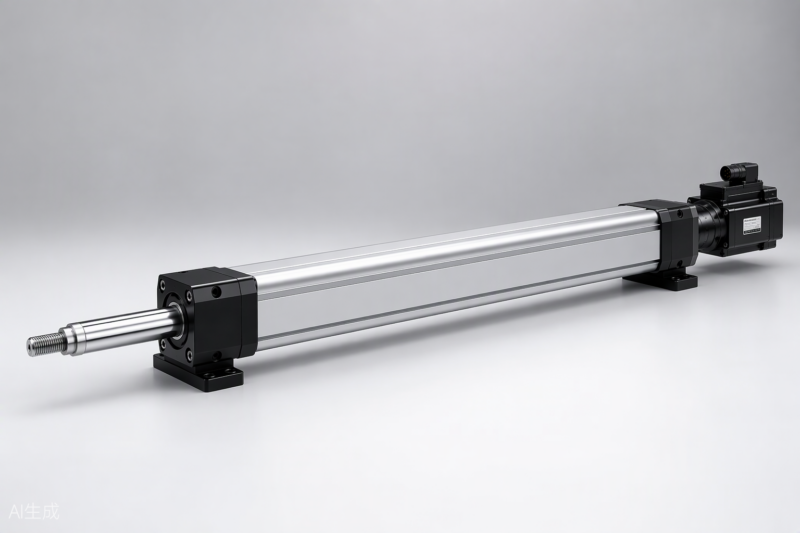
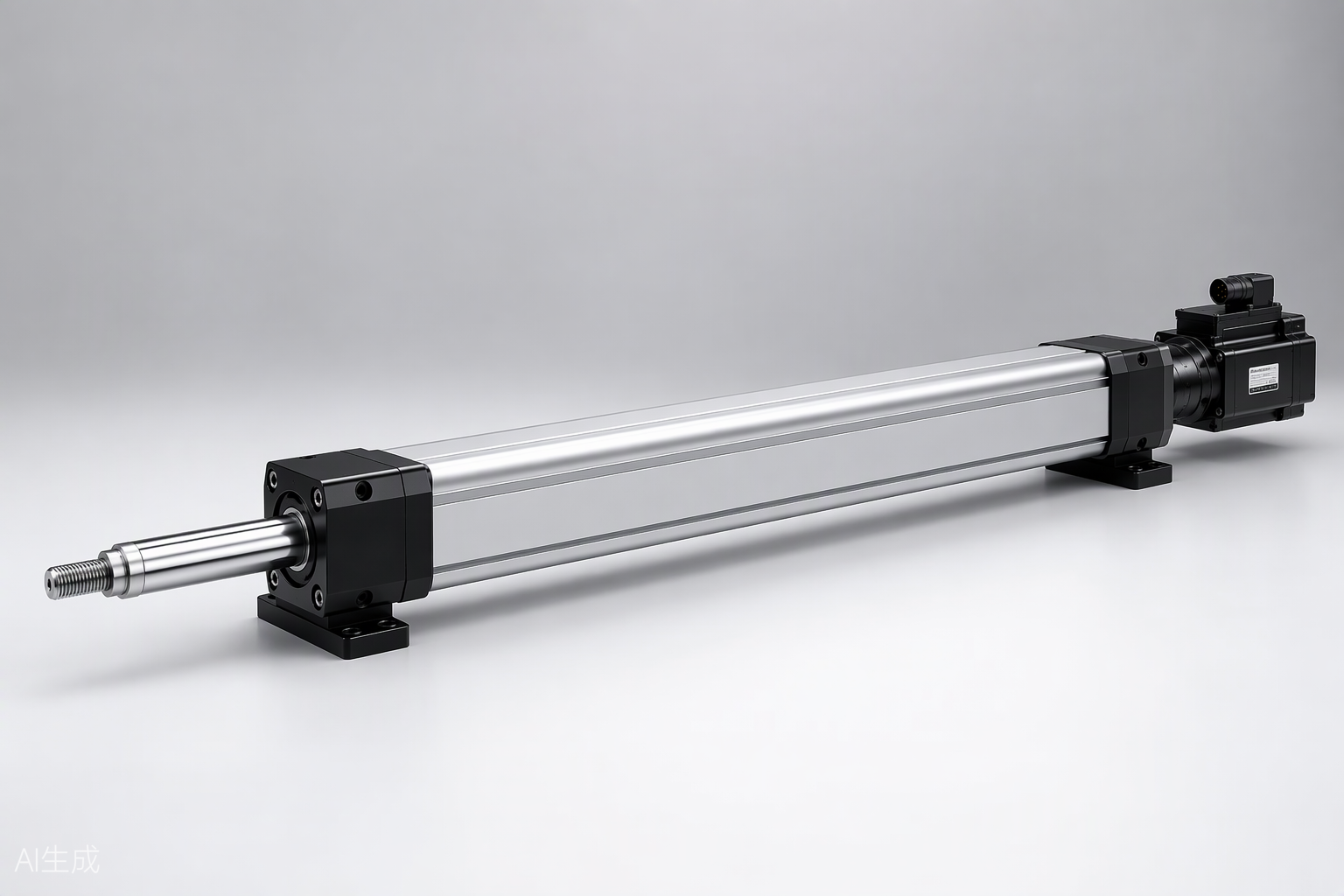
Figure 1. A 2000 mm stroke length electric cylinder with inline servo motor, extruded aluminium barrel and chrome-plated piston rod.
1. What Does a 2000 mm Stroke Length Electric Cylinder Offer?
An electric cylinder converts the rotary motion of a motor into precise linear motion through a screw mechanism. The model examined here is a servo motor linear actuator built around an inline architecture: the servo motor and planetary gearbox sit on the same axis as the ball screw, minimising the overall envelope and eliminating the efficiency losses of belt or right-angle drives. Its headline specifications define the class it competes in:
| Parameter | Specification |
| Stroke length | 2000 mm (custom strokes up to 2500 mm available) |
| Maximum thrust | 5000 N (push and pull) |
| Maximum speed | 100 mm/s |
| Drive system | Inline AC servo motor with planetary gearbox |
| Screw | Precision ball screw, 50 mm diameter, 10 mm lead, C5 accuracy |
| Repeatability | ±0.02 mm |
| Protection class | IP54 standard, IP65 optional |
| Operating temperature | -10 °C to +60 °C |
Two numbers deserve attention. The first is the stroke itself: at 2000 mm, this unit sits at the boundary where standard catalogue cylinders end and engineered long stroke linear actuator solutions begin. The second is the force-speed product. Delivering 5000 N at 100 mm/s continuously requires roughly 560 W of mechanical power at the screw, which is why a 750 W servo motor is specified — the margin covers gearbox efficiency, acceleration reserves and thermal headroom.
2. Why Is Long Stroke So Difficult?
Doubling the stroke of an electric cylinder is not a matter of making every part twice as long. Three physical limits dominate the design of any long stroke electric cylinder, and each one becomes more punishing as length grows:
Screw buckling. A ball screw transmitting 5000 N in compression behaves like a slender column. For a 2.2 m screw length, Euler buckling analysis shows that a 40 mm screw would fail below 3000 N — not enough. Upsizing to a 50 mm diameter screw with a root diameter of about 44 mm raises the critical buckling load to roughly 7900 N, restoring a safety factor of about 1.6 under full thrust, and more when the mounting uses a fixed-supported bearing arrangement.
Critical speed. Every rotating screw has a whip frequency above which it becomes unstable. For a 50 mm screw spanning 2000 mm, the critical speed is approximately 1600 rpm. At the required 100 mm/s output with a 10 mm lead, the screw turns at only 600 rpm — comfortably below the limit, with margin for occasional faster repositioning moves.
Sag, straightness and thermal growth. A two-metre screw deflects under its own weight; the barrel extrusion must be straight to within fractions of a millimetre along its full length; and a 20 °C temperature rise makes a steel screw grow by almost half a millimetre. None of these effects exists in a 200 mm cylinder, and all of them must be engineered away in a 2000 mm stroke length linear actuator.
3. Inside the Long Stroke Design

Figure 2. Cutaway of the internal structure: servo motor, planetary gearbox, support bearings, precision ball screw, guided nut and piston rod.
3.1 The ball screw: oversized, precise and tension-managed
The screw is the backbone of the entire actuator. A 50 mm diameter, 10 mm lead, C5-grade precision ball screw is selected — larger than the thrust alone would demand, because buckling, not stress, is the governing constraint at this stroke. The fixed drive end carries a matched pair of angular contact bearings preloaded in a back-to-back arrangement to absorb axial thrust in both directions. The far end is a floating support that allows the screw to expand thermally without building up internal compression — the feature that neutralises the half-millimetre of thermal growth calculated above. The recirculating ball nut is preloaded to eliminate backlash, which is what makes the ±0.02 mm repeatability figure achievable over the full stroke.
3.2 Servo motor and planetary gearbox
As a servo motor linear actuator, the cylinder uses closed-loop control from the start: the motor’s encoder reports rotor position thousands of times per revolution, and the drive translates that into piston position with sub-encoder-count resolution. Between motor and screw, a planetary gearbox with ≤3 arcmin backlash multiplies torque so that a compact 750 W motor can drive 5000 N continuously. The inline layout keeps the drivetrain coaxial, which matters more than it might seem — any offset belt drive would add radial side loads to a screw that is already two metres long.
3.3 Guidance and anti-rotation
The ball nut must translate without rotating, and over 2000 mm any angular error becomes visible at the rod end. The solution is a dual guidance system: two linear guide rails run the full length of the barrel interior, carrying the nut carriage on recirculating guide blocks, while a keyed anti-rotation mechanism between nut and piston rod guarantees that output rotation stays at zero. This arrangement also lets the actuator tolerate modest side loads — a frequent real-world condition when a long stroke linear actuator pushes against a misaligned fixture.
3.4 Barrel, piston rod and sealing
The outer barrel is a high-strength extruded aluminium profile with a hard-anodised surface. Extrusion is chosen over machining because it holds tight straightness over long lengths, integrates the guide-rail seats directly into the profile, and keeps the moving mass low. The piston rod is chrome-plated high-strength steel; at full extension, two metres of rod must resist bending under its own weight, so rod diameter is sized for column stiffness, not just tensile stress. A rod-end wiper and lip seal keep dust out of the nut, and the end cap retains long-life grease so that relubrication intervals stretch to tens of thousands of operating hours.
3.5 Feedback and safety
Over a two-metre stroke, position feedback cannot rely on the motor encoder alone without referencing: the cylinder therefore includes end-of-stroke limit switches for homing and over-travel protection, and an optional absolute linear encoder closes the loop directly at the carriage when the application demands certified positioning. For vertical installations, a motor holding brake prevents the 5000 N drive from back-driving under load when power is removed — a ball screw with a 10 mm lead is not self-locking.
4. Where Is a 2000 mm Stroke Length Electric Cylinder Used?
Figure 3. Two typical long stroke applications: a single-axis solar tracker (left) and a heavy-duty pusher on an automated line (right).
Solar tracking systems. Single-axis trackers in utility-scale photovoltaic plants rotate tonnes of panels through roughly ±45° every day. A 2000 mm stroke length linear actuator mounted between the pile and the torque tube converts that long linear travel into the required angular swing, and 5000 N covers the wind load of a large tracker row. Compared with hydraulic drives, the electric cylinder eliminates fluid leaks in the field, consumes power only while moving, and reports its exact position to the plant controller — one reason long stroke electric cylinders have become the default drive in new tracker designs.
Automotive and general assembly. Body-in-white framing stations and powertrain lines use long stroke cylinders to position welding frames, open and close heavy gates, and index body skids. A practical example: an engine plant replaced a hydraulic pusher that moved 400 kg engine pallets over 1.8 m with a 2000 mm stroke servo motor linear actuator. Cycle time stayed the same, but oil maintenance disappeared and the positioning window tightened from ±2 mm to ±0.1 mm, which allowed the downstream robot to stop re-gripping.
Logistics and packaging. Palletisers, depalletisers and layer-pushers need to sweep full pallet widths — typically 1200 to 2000 mm — while pushing loads of several hundred kilograms. Here the 100 mm/s speed and 5000 N thrust of this long stroke electric cylinder class match the duty almost exactly, and the clean electric drive is welcome in food and pharmaceutical logistics where hydraulic oil is prohibited.
Stage, architectural and test machinery. Retractable seating platforms, orchestra lifts, adjustable acoustic banners and material-testing frames all share the same pattern: a long, quiet, precisely repeatable push. A theatre installation using paired 2000 mm stroke cylinders to raise a 900 kg platform can synchronise both axes electronically through the servo drives — no flow dividers, no hydraulic power unit humming under the stage.
5. Selection and Installation Tips
If you are specifying a long stroke linear actuator of this class, keep four checks on your list. First, confirm the mounting: horizontal installations should support the barrel near its midpoint or use the integrated T-slots to restrain barrel deflection. Second, respect the buckling derating curve — maximum thrust applies to compression direction with the specified end fixity. Third, plan the duty cycle: at 100 mm/s and 5000 N continuously, verify the thermal rating of motor and gearbox with the manufacturer. Fourth, for vertical axes, order the holding brake. A correctly applied 2000 mm stroke length electric cylinder will outlast the machine around it; a misapplied one will wear its nut in months.
A 2000 mm stroke length electric cylinder is not simply a stretched version of a standard product. It is the result of deliberate engineering: an oversized precision ball screw chosen for buckling rather than stress, a fixed-floating bearing scheme that absorbs thermal growth, full-length internal guidance, and a closed-loop servo drive that keeps two metres of travel accurate to hundredths of a millimetre. Whether it is tracking the sun across a solar field, indexing engine pallets, sweeping pallet layers or lifting a stage, the long stroke electric cylinder with 5000 N thrust and 100 mm/s speed has become the clean, controllable successor to hydraulics — and the specification to beat in the long stroke linear actuator market.